
Introduction:
The MOST viral article I have ever written was a research paper titled "The top 10 reasons why 90% of all eCommerce startups fail within the first 120 days".
It analysed the interviews of 1200 business owners who gave their opinions as to why they think their eCommerce businesses failed. Click here to read this research.
This article focuses on the three core strategic principles that drive resounding eCommerce success.
Watch the video below which summarises this entire article or read on to see the detail behind these three proven strategies...
When analysing the top-performing eCommerce businesses worldwide, they all have one thing in common: the activation of these strategies to a very high standard.
They are…
- Creating digital journeys that match consumer buying needs and engagement preferences.
- Leveraging the right technologies to enable great digital experiences and enrich product databases.
- The Acquisition/Retention Ratio.
Strategic Principle #1. Creating Digital Journeys that Match Consumer Buying Needs and Engagement Preferences
Importance of Consumer-Centric Journeys
Successful eCommerce businesses place the consumer at the centre of every digital touchpoint. A consumer-centric journey is not just about guiding shoppers from the landing page to checkout; it’s about understanding motivations, expectations, and preferred engagement methods.

Customers expect seamless, personalised experiences that align with their own buying needs. And if your retail (or B2B) site does not meet these needs, the consumer will try to reach you for help, or, more commonly, move on to your competitor.
Why do you think LLMs like ChatGPT are popular? It’s because an entire information-gathering and buying journey can be conducted on a single screen (interface), where the consumer can ask multiple questions and receive highly relevant responses.
LLMs have become popular because of the poor job online retailers have been doing for the last three decades.
The good news is, it's not too late. Consumers still want to interact with retail brands. Research verifies three things…
- Consumers prefer to engage directly with retail sites because they perceive the information is better from the source.
- Consumers feel that the product returns option and product warranty are honoured to a higher standard when purchasing directly.
- When consumers use an LLM (like ChatGPT) for discovery, most consumers click through to the retailer to verify pricing, product details and availability before buying.
So it’s time to lift your journey game.
Tips for Improving Relevant Customer Journeys:
Listen!:
Analysing behavioural data, such as browsing patterns, purchase history, and feedback, helps identify pain points and preferences.
Journey Mapping:
Mapping the digital journey from discovery to post-purchase support reveals gaps and opportunities for improvement. Visualising the journey helps prioritise enhancements that matter most to the consumer.

AI Tool Integration:
If done right AI tools can personalise and enhance journeys. However, rushed or superficial AI adoption will backfire, resulting in frustrating experiences. AI should be implemented thoughtfully, with a focus on augmenting, not replacing, human touchpoints.
Employee Accessibility:
To the point above about “human touchpoints”, there needs to be the ability for consumers to speak to an employee (an actual human) when they need information that is not found in the digital journey.
When this interaction occurs, you're likely to close a sale and gain new insight into what other content should be introduced into digital journeys: win-win!
Strategic Principle #2. The 2 Foundational Technologies: Enable Consumer Journeys and Enrich Product Database
While the eCommerce industry is flooded with thousands of technologies that claim to be the “silver bullet” to eCommerce business success, businesses need to focus on getting two specific technologies right to set the foundation for success…
- An eCommerce platform to enable consumer journeys
- A software system that holds and enriches your product master data
The reason this is strategic is that you can get other technologies a little wrong and still grow your eCommerce business.
You can select the incorrect live chat tool or customer review system, and you are still OK. But get these foundational technologies wrong, and you are in big trouble.
eCommerce Platform – The Role of Technology in Enabling Journeys
You may have a clear view of how you need to engage with your customers, but if you do not have the right eCommerce technology to enable these experiences, you will never be successful.
These eCommerce platforms need to meet your consumers' current engagement needs, AND be nimble enough to meet all future engagement needs.

eCommerce Platform TIP:
All eCommerce platforms are not created equal. If you are considering replacing your current eCommerce platform with a newer one, activate an RFP (Request For Proposal) process. You have a fiduciary responsibility to follow best-practice processes to select the ideal vendor and eCommerce platform.
Product Master Data Enrichment System
Product master data is the backbone of any successful eCommerce business. There is a direct correlation between online retail success and the quality of your product master data.
Consider the research below…
- Businesses that implement a PIM (product information management system) and use it to enrich their product data experience conversion rate increases of 25% to 50%.
- Rich product master data is associated with a reduction in product returns of between 20% to 50%.
Rich, accurate, and well-structured product information enhances site searchability and consumer decision-making. This not only improves the shopping experience but also supports SEO and LLM visibility and accessibility.
Product Enrichment Tip:
There are two parts to product enrichment…
Part 1:
Having a dedicated system to hold your product master data (commonly referred to as a PIM).
Part 2:
Activating automated (AI) logic and intelligence to enrich the master data. There are proven AI-based systems specifically designed to achieve this outcome. Tread carefully here, but be aware that this method is proven and adds scale to your product onboarding workflows.

Strategic Principle #3. The Acquisition/Retention Ratio
Research verifies that acquiring new customers is always more expensive than retaining existing ones.
Between 60% to 70% of all first online retail purchases are "loss-making" for a retailer.
The acquisition/retention ratio refers to the balance between investing in attracting new customers and nurturing existing customers to come back.
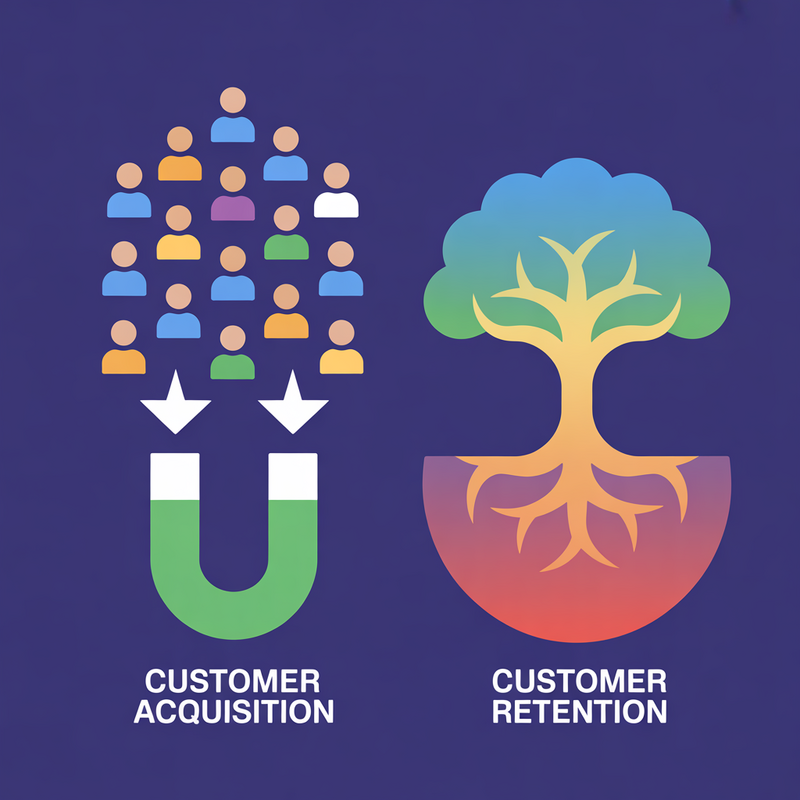
When an eCommerce business is new, it’s easy to fall into acquisition mode. This is both a blessing and a curse.
The curse is that an eCommerce business will do anything to bring on a new customer. But this is not sustainable, which is why 90% of eCommerce businesses fail within the first 120 days.
Successful eCommerce businesses understand retention drives profitability through repeat purchases and advocacy. This ratio forces businesses to devote as much focus to the retention function as they do to acquisition.
There needs to be a balance.
Acquisition/Retention TIPS:
Beware of rushing into a Loyalty System:
It’s easy to think a Loyalty/Rewards system will solve your retention issues. But if this system is not designed to add value to humans, it will not work. Know your customers first.
Keep Listening!
The listening does not stop once the first purchase is complete. Introduce data-capture systems that enable you to understand what your customers love about your products and services. This data will provide insights into how to create meaningful post-purchase experiences.
This is what brings people back, and this will inform how to set up loyalty systems.
This form of data capture also helps you understand what happy customers look like and will dictate future acquisition activities. If you can profile your existing customers, you will have clarity over what future customers look like.
This will drive a higher level of targeted marketing activities.
Targeted Acquisition:
Use data-driven digital marketing activities to attract the right customers to your business. And activate a high degree of accountability for all digital marketing investment. Never accept poor campaign performances.
Conclusion: Recognise both the Complexity and Opportunity in eCommerce
eCommerce is the most complex business channel in history. This digital channel develops and configures technologies to deliver interactive, engaging experiences with humans through an interface/screen slightly larger than the palm of your hand.
And this is done through the most impersonal medium ever created... the internet.

Added to this is the triple threat of continuously shifting consumer behaviours, rapid technological innovation, and intense competition.
The exciting news is that adhering to the above strategic principles lays the foundation for your eCommerce business success.
Collaborate with an eCommerce Specialist
To activate the above strategies is a journey you and your business need to undertake. This eCommerce business journey requires a mentor, guide, or "Captain" to steer you toward the right choices and protect you from the noise and treachery of poor decision-making that can set you on the wrong trajectory.
It’s important to recognise the need for collaboration with an eCommerce specialist.
While this collaboration may be perceived as an unnecessary cost, the real risk is making the wrong decisions that lead to no growth and, ultimately, business failure. That is the real cost.
For help defining your eCommerce priorities and roadmap, explore Comma Consulting's eCommerce strategy and strategic planning services.
Or learn more about Greg Randall's eCommerce consulting experience.
This article was as tagged as AI eCommerce , Data Driven Decision Making , Digital Strategy , eCommerce Consulting