
A client called me in to review a digital onboarding experience for new customers which involved filling out a registration form.
At first glance, the form looked reasonable:
- Had a reasonable number of form fields
- The Form Labels (titles) were fine
- It had a call-to-action button
- It required consent checkboxes
Yet I immediately knew the form would underperform.
This example highlights a much deeper observation about customer experience design and why the majority of digital experiences underperform.
The Core Observation
When diagnosing this forms experience, the majority will evaluate it based on what they can see.
But producing successful digital journeys requires a deep evaluation of what people will think, how they will react, and what they will experience while trying to achieve successful form completion to be onboarded.
This takes the method of diagnosing and enhancing journeys to a new level.
There are numerous anxious moments people have when filling out a new form for the first time. Some examples…
- Am I completing this correctly?
- What happens next when I select the button?
- What happens if I make a mistake?
- Why are they asking for this information?
- Can I trust this from with my personal details process?
Every one of these questions introduces friction and cognitive load. Those are the fancy terms, to a human, its anxiety and risk.
The Real Problem
The issue is not forms, design or AI.
The real issue is poor digital experiences force customers into unnecessary conscious evaluation. In other words, the subconscious mind, which should be in control, is replaced with the human brain being activated to complete tasks.
The moment the subconscious mind (your mental autopilot) loses control to the conscious mind, momentum is halted.
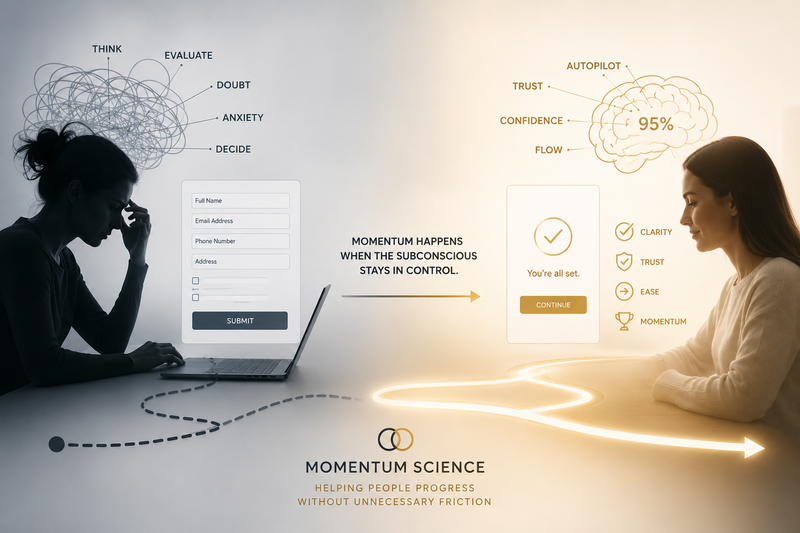
Harvard Medicine supports this with research proving that around 95% of successful online buying journeys are completed when the subconscious mind is in control. Click here to see this research.
Over time I started noticing the same journey patterns across online retail, B2B, SaaS, banking, insurances, travel, and many other digital experiences where people embark on multiple digital steps to meet a need.
The businesses that performed best weren't necessarily using better technology.
They were better at helping people progress towards an outcome without creating unnecessary friction.
I now call this Momentum Science.
The Momentum Science Perspective
Customers should not be forced to repeatedly stop, evaluate and reconsider their actions.
The best digital experiences allow people to progress naturally.
Not because the journey is simple, but because complexity has been removed.
This method transcends online retail. It applies to any digital journey that meets the need of a human.
- It can be a B2B journey
- People looking for the right life insurance policy or a home mortgage.
- Booking flights for a holiday.
- Someone signing up to an enterprise SaaS system.
The scenarios are endless, but the momentum science principles remain unchanged.
Why Momentum Science Matters
Many organisations focus on:
- User Interface Design
- Visual Design
- Website Features
These elements are a piece to a bigger puzzle and only partly addresses the visible layer of the experience.
The behavioural layer is where success or failure occurs.
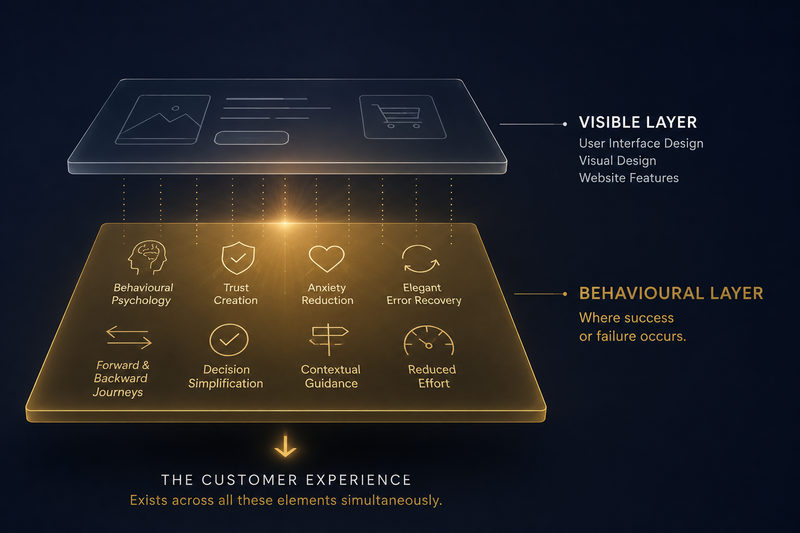
This encompasses…
- Behavioural psychology
- Trust creation
- Anxiety reduction
- Elegant error recovery
- The creation of intuitive forward AND backward journeys
- Decision simplification
- Contextual guidance
- Reduction in physical and mental effort (interaction cost)
Amazing digital customer experiences exists across all these behavioural layers simultaneously.
The AI Observation – Blessing or Curse
AI-generated customer experiences highlight an important challenge.
AI can generate screens and page layouts but it does not understand:
- Customer behavioural psychology in the context of digital journeys
- What motivates people to act when they have intent
- Recognizing there are various levels of intent in different moments and it changes dynamically
- Customer pain points
- Commercial objectives
And the above is mixed together with the strategic and commercial objectives of a business.
Businesses find the above customer-centric dynamics too hard to figure out and hope AI can do it for them.
This notion becomes a “blessing” in the context that it gives the perception it can doing the heavy "digital experience" lifting for a business. Ultimately it becomes an AI “curse” because it can’t do it on its own.
AI needs to be supported by Momentum Science.
Customer experience design is less about what customers see and is more about managing the amount of conscious thought required to reach an end defined by a human.
The COVID Observation:
During COVID many commentators claimed customer behaviour had changed.
I disagree!
What changed was people's ability to satisfy their needs through traditional retail channels.
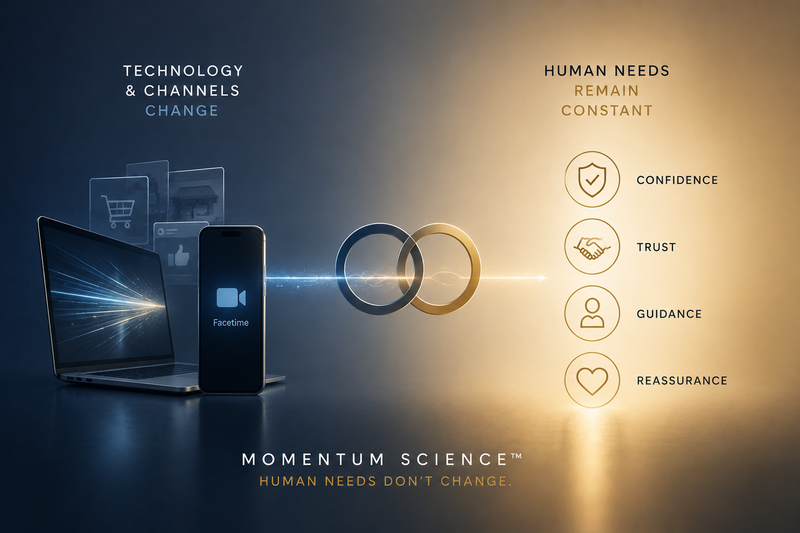
The need for trust, confidence, guidance and reassurance remained exactly the same.
People still wanted to...
- Speak with experts
- Have their questions answered
- Get help making decisions
- Gain confidence before committing
The difference was that physical interactions were no longer available.
Luxury retailers responded brilliantly by using technologies such as FaceTime and video consultations to recreate one-to-one selling experiences remotely.
The technology wasn't the innovation.
The ability to continue delivering trust, guidance and reassurance remotely was the innovation.
COVID reinforced an observation I had been making for years.
Technology changes rapidly. Human needs change slowly.
Momentum Science exists because digital success is rarely determined by technology alone.
It is determined by how effectively technology supports enduring human needs.
Conclusion – The Physical Sales Experience
Think back to a moment in time where you engaged with a physical salesperson that was so enjoyable you didn’t want it to end.
The salesperson…
- Spoke your language and did not use confusing jargon.
- Gave you the right information after you asked questions – so it felt like you were in control of the experience – and it felt personal.
- The way the information was presented was easy to understand.
- The information provided made your decision-making process easy.
While the above experience felt personal and unique to you, the salesperson delivers a very similar version of that same experience hundreds of times before. And will continue to do the same hundreds of times in the future!
These frontline sales people understand the behavioural patterns of people to produce a successful end-to-end sales experience.

Those same behavioural patterns can be designed into digital experiences. This is Momentum Science...
The act of humanising digital journeys
In summary, technology will continue to evolve. Your customers will continue to seek trust, confidence, guidance and reassurance.
The real question is:
Are you designing for the technology, or the human using it?
For help defining your eCommerce priorities and roadmap, explore Comma Consulting's eCommerce strategy and strategic planning services.
Or learn more about Greg Randall's eCommerce consulting experience.
This article was as tagged as AI eCommerce , Best Practice , Digital Strategy , eCommerce Consulting , UX Design