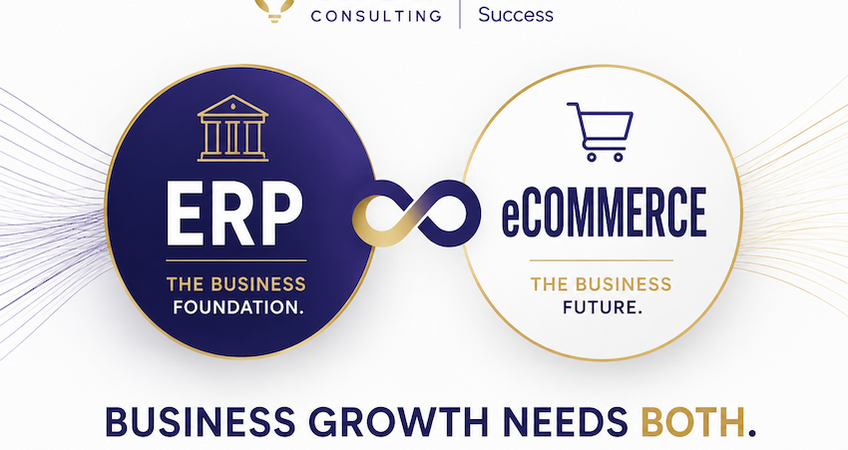
ERP implementation is evolving because business software ecosystems must become far more connected. There was a time when an ERP project could largely operate within its own boundaries.
The ERP has its own critical role to play, but it is also one piece of a much bigger architectural puzzle. Its power and utility are now twofold: how it can hold data, and more importantly, how it can share data.
This is particularly important for eCommerce platforms that are “data hungry”: data directly influences customer experiences.
From a growth perspective, the ERP is the business foundation and the eCommerce channel is the business future.
This makes these two systems symbiotic, which means the specialists responsible must work symbiotically too.
This is where an eCommerce expert adds value, to bring an understanding of how the ERP supports great end-to-end customer journeys.
eCommerce projects are often delayed waiting for ERP projects to finish, which in turn delays the evolution of the eCommerce channel.
An experienced eCommerce specialist is there to...
1. Answer the eCommerce-specific questions
2. Represent the digital-channel implications (the end-to-end journeys)
3. Represent the customer
4. Protect the business
The result is greater client confidence in, the project, the ERP system and the ERP consultant.
Modern ERP projects don't need ERP consultants to become eCommerce experts. They need the right eCommerce expertise.
It takes a village.
For help defining your eCommerce priorities and roadmap, explore Comma Consulting's eCommerce strategy and strategic planning services.
Or learn more about Greg Randall's eCommerce consulting experience.
This article was as tagged as Best Practice , Digital Strategy , Digital Transformation , eCommerce Consulting