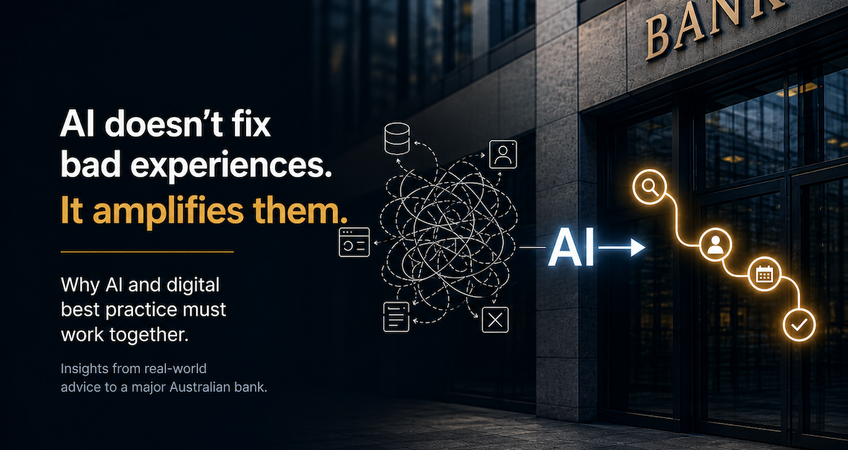
This time last year, a major bank called me in and asked my opinion on their plan to overlay AI onto their existing customer facing website to enhance customer journeys and people’s ability to self-serve and find new products, sign up for mortgage appointments and apply for loans.
What struck me during those discussions was the enormous enthusiasm for what AI might be able to do, but considerably less attention being paid to the quality of the underlying customer journeys, data and digital foundations that AI was going to be applied to.
That was concerning because AI cannot magically repair poor customer experiences.
In fact, the application of sophisticated technologies to journeys that are already complicated, fragmented or simply not following established digital best practices creates more problems than it solves.
This real-life example of what businesses are trying to do to mask poor customer experiences prompted me to write a research paper (click here to read) explaining how and why AI and ecommerce/digital best practices must work together.
Put simply, you begin by understanding what the customer is trying to achieve and remove unnecessary effort and friction. Then use AI in the parts of that journey where it can genuinely improve the experience.
The key nuance is that AI should be used in “parts”. It should take on specific roles within the journey. It is not there to take over and own the entire experience.
This is where large bigger businesses get it wrong. They look at AI as something that can sit across and improve the entire customer experience, rather than identifying the specific parts of the journey where AI can perform a clearly defined role better.
The customer journey still needs to be designed. AI is one of the tools you use within that design.
There are numerous other experience design principles and behavioural psychologies that sit behind the oversimplified explanation above, but you get the gist of it.
A year later, this is becoming more important. Businesses have now spent considerable time and money experimenting with and implementing AI, and many are reaching the point where they need to reconcile that investment with actual commercial performance.
AI can undoubtedly create capability, but if the underlying customer journey, data, systems or operating model are not working properly, adding AI does not make those problems disappear.
AI works best when it is applied to good foundations, rather than being expected to compensate for poor ones.
Click here to read the article from last year.
Greg Randall's perspective
AI should not determine the customer journey. The customer journey should determine where AI can genuinely improve the experience.
This is why I have always believed customer journeys need to be properly understood and designed before businesses start deciding which technologies should be introduced. AI is another capability within that journey, not a replacement for the thinking required to design it.
This article was as tagged as Agentic Commerce , AI eCommerce , Digital Strategy , Digital Transformation , eCommerce Consulting