Google has announced a significant expansion of its role in eCommerce.
Through its new agentic commerce capabilities, consumers can start a typical search journey for products, and now remain within Google to complete a purchase without ever going to a retailer's website. Tapestry is one of the first major retailers to activate the capability with selected Coach and Kate Spade products in the US.
Google already sits in front of enormous consumer demand, and now itwants to participate further into the journey, including the transaction itself.
And that creates a much bigger strategic question for retailers...
If Google helps me win the order but makes it harder for me to win the customer, what exactly have I won?
Who Benefits?
Before becoming too excited, you, the retailer need to sit and digest this "opportunity" through the lens of to two key audiences...
- Is it better for humans?
- Is it better for my business model?
If these two boxes cannot be ticked, why bother?
That is the test that needs to be applied to Google's proposition:
Google appears to believe humans want an end-to-end purchasing experience within Google's ecosystem. Says who? That is yet to be proven.
And to answer the benefit question, you need to understand more about what Google is proposing....
- Single checkout journey for every retailer across all product types
- Only delivery to home is available
- Strict rules to receive your product master data
- You must still fulfill the product
- You must still honour warranty and returns
- You must still pay for the privilege to advertise on Google and pay it a commission for every sale that comes thorugh this new system
Why is this problematic?
This apparent "opportunity" has many cautions that retailers need to be aware of....
Single fixed checkout journey:
Google is attempting to standardise enormous retail variation within a single "Google-controlled" checkout experience.
Successful online retailer introduce unique nuances to their checkout journeys for a reason. Unique products, unique warranties, unique delivery or fast delivery options, click and collect services, all require specific steps within a checkout journey to enable retailers to fully leverage their omni channel strategy.
I have literally designed hundreds of checkout journeys for hundreds of retainers and they all have small unqiue treatments that make it important to customers to complete the transaction.
Historically this method of a single checkout has not been a big success.
The Shopify Checkout Exmaple:
Shopify has already taught us something about “simple” checkout. Shopify has espoused the virtues of its one-page checkout and the idea that a ubiquitous checkout makes life simpler for humans.
But the evidence is interesting.
Shopify's own 2026 checkout benchmark data shows 76% of all engagement on their one-step checkout occurred on mobile screens and its mobile checkout has a cart abandonment rate of 81.72% as of April 2026.
A decade ago, Barilliance was already reporting mobile cart abandonment at 85.65% in 2015! A decade of checkout innovation later, current industry benchmarks remain around that level.
You cannot reference Amazon inot this because that retail juggernaut has simplified checkout journeys because it has all the customers information and buying details ahead of time. And people go to Amazon with the intent to purchase from that retailer. Consumers do not start their journey in Google with the intent to complete a transaction.
Product Selection Micro-Journeys:
Product detail pages have over 30 functional elements all designed to achieve a single purpose...to merchandise, sell and simplify the selection of a product for a consumer. I have written an entire book on product detail pages and the complexity behind how this page needs to work to make it easy for consumers.
Consider the the online retail dynamics of products...
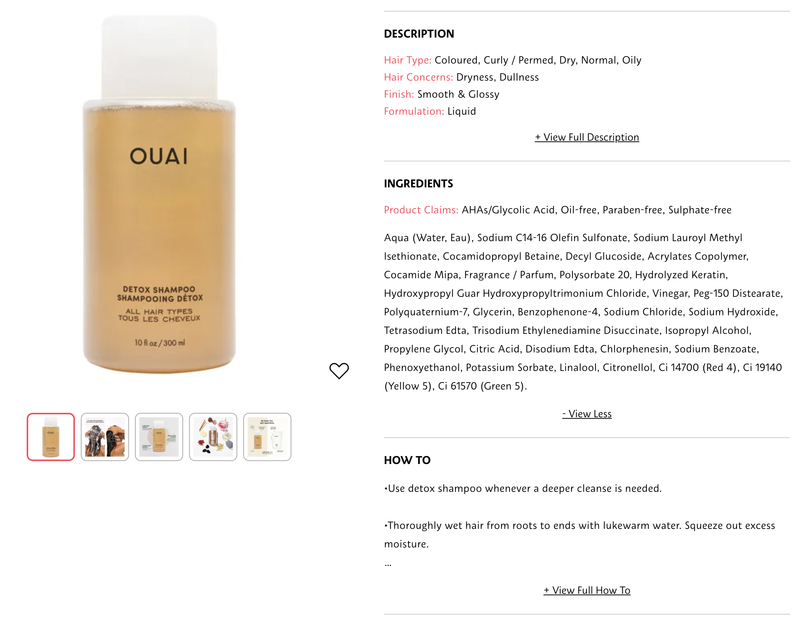
Many have variants such as size and colour. A lipstick can easily have over 20 shades.
Consumers want to understand their delivery and pick up options and delivery costs AT the product detail page.
Size guide content is a critical mechanism in selling garments and a simple table is no longer enough.
Returns?
What happens to returns?
If removing parts of the retailer's product-selection experience makes it easier to transact but harder for the customer to choose the right product, any conversion improvement needs to be measured against the cost of additional returns.
Making it easier to buy the wrong product is not adding value to the business.
Data Transfer:
The need to meet Google's agentic protocols is not straightforward.
Retailers' product master data continues to be notoriously messy.
Retailers have heard seen this movie before - Marketplaces:
Many retailers will already have another experience playing through their heads as they consider this proposition: Marketplaces.
Marketplaces was the exciting new channel that was going to broaden retail reach and drive growth.
The proposition was strong, put your products into another consumer environment designed to facilitate a purchase the retailer may not previously have reached.
For most retailers, the effort has not translated into the growth they expected.
This time around its Google, so the "marketplace" is different by the propsoation is similar.
If Google wins the transaction, can the retailer win the customer?
Google taking the transaction doesn't make the retailer's operational obligations disappear.
The order still needs to be pulled into the reatiler's infraustruction so the order can be fullfilled.
The consumer-facing transaction may look simpler while considerable complexity remains behind it. This also means all the business costs to get the order remains the same.
Google has its strategy. Retailers need theirs.
This article was as tagged as AI eCommerce , Digital Strategy , eCommerce Consulting , UX Design