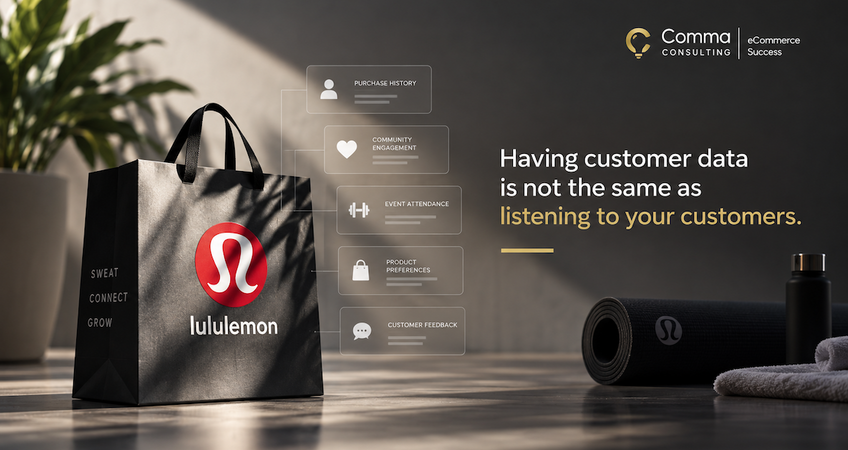
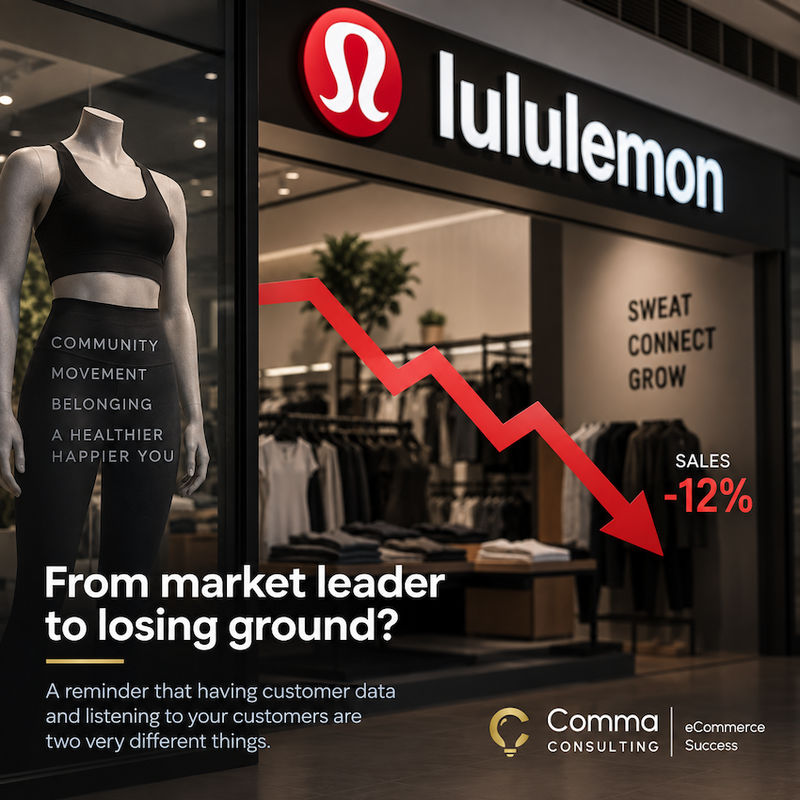
Lululemon has spent years building loyalty, community and an extraordinary amount of first party customer data, yet this retailer has gone from market leader to sales being down 12% while losing market share to upstart competitors.
So what did this retailer miss?
Back in 2018, I wrote an article about the characteristics of successful loyalty programs and used Lululemon as one of my examples.
At the time, I highlighted how they were using gamification to progressively enrich customer profile data and learn more about their customers.
On top of this, Lululemon has built a business with an unusually close relationship with its customers...
- Community events
- Ambassadors
- Yoga classes in stores
- Strong store experience
- Online retail
All the above creates opportunities to listen and learn. This is precisely what most retailers have spent years trying to achieve.
And yet competitors have gained ground and Lululemon's executive team is now talking about the need to strengthen its product offering.
I don't know what happened inside Lululemon, but the situation raises a much more interesting question for every retailer investing heavily in loyalty and customer data....
Are you collecting customer data for the sake of it, or are you actually listening?
I wrote about this eight years ago
In that 2018 article I made this observation:
Successful retailers harness customer data they are gathering and apply it throughout the business.
That distinction matters.
The commercial value of customer data does not come from possessing it. The value comes from what the business learns from it and what it subsequently does differently.
Retailers understandably measure loyalty activity through outcomes such as repeat purchase. If customers return and buy again, the loyalty investment appears to be working.
But there is another return from these investments that is much easier to overlook.
The business should be getting smarter.
Every interaction with an existing customer creates another opportunity to understand what that customer values, what is changing, what is frustrating them and what they may want next.
That knowledge should influence more than the next marketing message. It should influence...
- Product design decisions
- Customer experience
- Post sales service
- Communication
- Education
Otherwise, the retailer may have built an increasingly sophisticated mechanism for collecting customer information without building an equally sophisticated mechanism for responding to it.
Listening is a commercial process
By listening, I mean using what customers tell you, through their behaviour, questions, feedback and interactions, to understand what they need and change what the business does as a result.
This is what good salespeople do naturally in face-to-face interactions. They listen, ask questions and use whatever they know about the customer to make the interaction more relevant.
The listening process should be continuous:
Listen → learn → act → create more customer value → generate commercial return → listen again
The last step is important...
- Customer expectations change
- Markets change
- Competitors change
- Products change
What customers valued three years ago may not be what they value today.
Listening therefore isn't a research project that gets completed, it's a continuous commercial capability.
And the more a retailer invests in loyalty, membership and first party data, the stronger that capability should become.
LLMs make this even more important
There is another reason this matters now.
LLMs are giving consumers increasingly enriched and contextual interactions. They can remember context, respond to questions and progressively understand what someone is trying to achieve.
That changes expectations.
Retailers already possess something potentially more valuable: information created through a genuine commercial relationship with the customer.
- Purchase history
- Preferences
- Behaviours, engagement, objections, questions, feedback
The opportunity is not simply to use that information to target the customer more effectively.
It is to use it to understand them better and improve the relationship.
Loyalty programs don't create loyalty
A loyalty program can
- Create incentives to return
- Encourage repeat purchases
- Create engagement
- Generate more customer data
But none of those things automatically create loyalty.
Customers want to feel heard.
If a retailer asks customers to provide increasing amounts of information about themselves, there is an implicit value exchange taking place.
The customer provides knowledge, and the retailer should become better at serving them.
Having customer data is one thing, but using it to listen to your customers is a very different thing.
Lesson of the day? Listen first. Act second.
About Greg Randall
Greg Randall is an eCommerce consultant and the founder of Comma Consulting. He has spent more than 25 years working with retailers and B2B's, helping them understand what is getting in the way of better digital performance.
His work combines eCommerce strategy, customer experience design, data and commercial pattern recognition to identify the issues that matter and what businesses should do about them.
This article was as tagged as AI eCommerce , Digital Strategy , Digital Transformation , eCommerce Consulting