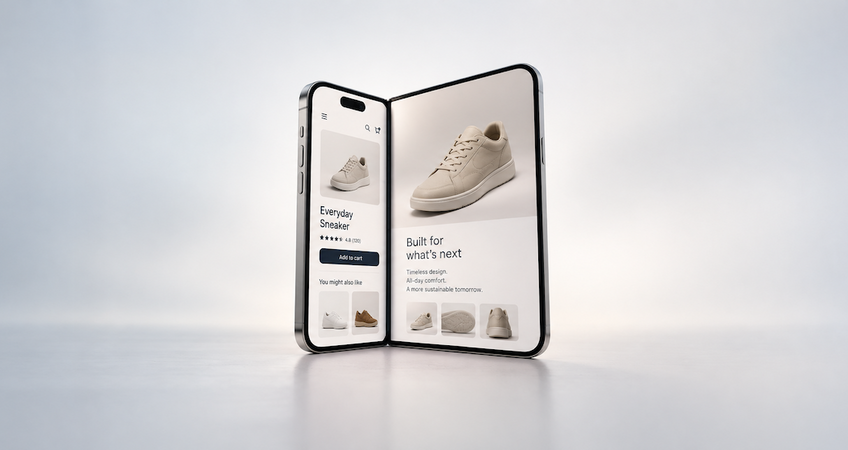
Apple Duo introduces something retailers have not had to seriously design for before: a customer moving between two very different screen experiences during the same shopping journey.
The foldable phone is not new! Samsung and others have been producing them for years.
What matters is whether Apple can make opening and closing the device feel so natural that consumers begin changing screen states as part of how they browse, evaluate and buy products.
This is what Apple does, they enter existing technology categories, remove friction and change consumer behaviour.
This is why retailers should pay attention to the Apple Duo.
The Problem with Foldable Phones Has Never Been the Fold
Existing foldable phones demonstrated the problem Apple needed to solve: the "fold to open" experiences.
For existing foldable phones, there are documented examples of poor experiences when pepople try to engage with the same digital content while moving from a folded to open screen...
- Applications restarting
- Pages refreshing
Google's own foldable design guidance addresses this known issue..
Users expect their state to be preserved when folding or unfolding a device. Losing position, selections or context creates a poor experience.
The foundation to intuitive digital experiences continuity. Every micro step a consumer takes from searching to buying must be obvious and seamless, which means the act of opening the device in the middle of a session, should become a seamless part of the customer journey.
THAT is the opportunity.
Why Apple Changes the Equation
As stated above, Apple has a history of being very good at being second.
It did not invent the smartphone, the tablet. the laptop, the MP3 player or wireless earphones.
Apple is exceptional at observing an existing technology category, understand product design issues which translate to consumer experience friction and create a version that is more intuitive.
Apple needs to make folding and opening the phone more useful and natural for people when they are in engagement mode.
If Apple achieves that, the important change for retailers is not the device, its is the behaviour the device creates.
A New Mobile Commerce Behaviour
This is where the rubber hits the road.
Mobile commerce has traditionally been designed around the limitations of a small screen, and retailers attempt to drive engagement in a very small space.
The Duo changes that constraint and gives the consumer the freedom to choose when they want to rapidly scan in "folded" mode, or enhance their own engagement in "open" mode.
That creates a multi-screen experience within a single device and a single session.
But this alone can translate to many experience design hurdles the retailer should now be considering. Below are just three examples of the types of things retailers need to consider in preparation for "Duo consumer behaviours"...
#1. Product Listing Pages Need to Preserve the Journey
Consider a consumer scanning a product listing page, the most commonly viewed online retailer page in eCommerce:
- They select a filter such as colour and begin scrolling through the results.
- Halfway through the product range, they open the Duo to make scanning easier.
The page now has to reconstruct itself for a significantly larger screen without making the customer work out where they are again. This experience just achieve the following...
- The selected filters remain
- Their position within the product range remains
- The layout changes, but the context for the consumer does not
#2. Product Detail Pages Become More Powerful Merchandising Environments
Product detail pages create an even more interesting opportunity. Imagine a consumer discovers a product while the Duo is folded, and creates enough interest to warrant the act of opening the device.
The retailer now has a larger surface on which to merchandise that product, but the page template needs to respond accordingly to produce this elegant transition. This is less technical intense than product listing pages, but the transition from a "mobile" layout to a larger screen layout needs to be planned.
The important design question is not simply how to make the existing product page bigger.
For retailers selling products where imagery, information and education influence the purchase decision, this becomes an important customer experience design consideration.
#3. Checkout Journeys Need to Transition Without Friction
Checkout creates another potential common scenario and big opportunity. A consumer can find a product on a small screen but open the Duo to complete the checkout journey.
This creates more space for a properly designed multi-stepped checkout journey to do its job: Cart, Sign in, Delivery Options, Payment.
Why is this relevant? The research still proves the multi-step checkout journey has far higher conversion rates than a 1 step, but retailers have always struggled in their mobile multi-step checkout design.
The larger screen provides more space for validation, delivery and pick up options, order summaries and other content that helps customers confidently progress through the transaction.
This is not a Responsive Tablet Design Solution:
Some will say to solve the examples above is simply the technical equivalent of creating a responsive design for a Tablet device (sigh). This could not be further from the truth because tablet journeys started the journey on a tablet. There was no "small to large" screen adjustment in the middle of the journey.
The interface must respond to a change in screen state while preserving an active customer journey. Put simply, the screen can change, but it must feel like its the same experience for the consumer.
This means everything the customer has already done (in folded mode) must survive the transition and more importantly be obvious to the consumer so they have the confidence to carry on.
Retailers do not need to redesign their websites for the Apple Duo today, but there is a need to have an awareness of the behaviours it introduces.
The Apple Duo Makes Mobile Commerce More Interesting
Nobody yet has evidence showing how consumers will use the Duo, but the psychological sciences help us understand what to expect.
These sciences dictate that consumers demand...
- To be in control of their digital journeys
- Want to engage with content when it helps their decsion making
- The brain is designed to react to visual content moreso than the written word
- Need constant cues that the technology is reacting to their selections
- People are lazy and want the path to least resistance
- They are always trying to reduce their risk and anxiety when buying online
This tells us that if a human has a need and/or the intent to buy, and moving from a smaller screen to a larger screen is going to contribute to meeting their intent, it will happen.
About Greg Randall
Greg Randall is an eCommerce consultant and the founder of Comma Consulting. He has spent more than 25 years working with retailers and B2B's, helping them understand what is getting in the way of better digital performance.
His work combines eCommerce strategy, customer experience design, data and commercial pattern recognition to identify the issues that matter and what businesses should do about them.
This article was as tagged as Digital Strategy , eCommerce Consulting , UX Design