Every purchase begins with uncertainty.
The larger the decision, the greater the uncertainty.
Businesses often assume customers buy when they become convinced.
They don't.
They buy when uncertainty falls to an acceptable level.
That distinction changes how businesses think about conversion.
Most organisations try to increase persuasion.
More features.
More benefits.
More marketing.
More urgency.
These tactics sometimes create attention.
They rarely create confidence.
Buying Confidence is the point at which a customer believes the risk of moving forward is lower than the risk of doing nothing.
It is not created by one moment.
It is created through a series of interactions that continually reduce uncertainty.
This is why confidence should never be treated as a page element.
It is a journey outcome.
Every unanswered question delays confidence.
Every unnecessary comparison increases effort.
Every inconsistent message creates doubt.
Every unexpected obstacle reduces momentum.
Customers rarely abandon because one thing goes wrong.
They leave because uncertainty gradually becomes greater than confidence.
Businesses frequently attempt to solve this problem with trust badges, testimonials and guarantees.
These all have value.
None create confidence by themselves.
Confidence emerges when the entire experience behaves predictably.
The customer understands what happens next.
The information arrives when it is needed.
Progress feels natural.
Nothing unexpected interrupts the journey.
Buying Confidence also explains why two customers can respond differently to the same experience.
One customer arrives almost ready to proceed.
Another arrives carrying significant uncertainty.
The experience is identical.
Their confidence is not.
This is why Customer Intent matters.
Different intentions create different confidence requirements.
Understanding those requirements allows businesses to remove uncertainty before it becomes hesitation.
At Comma Consulting, Buying Confidence is not viewed as a marketing objective.
It is a commercial mechanism.
Confidence increases when businesses reduce effort, remove uncertainty and help customers progress naturally towards a decision.
Momentum Science explains how confidence develops.
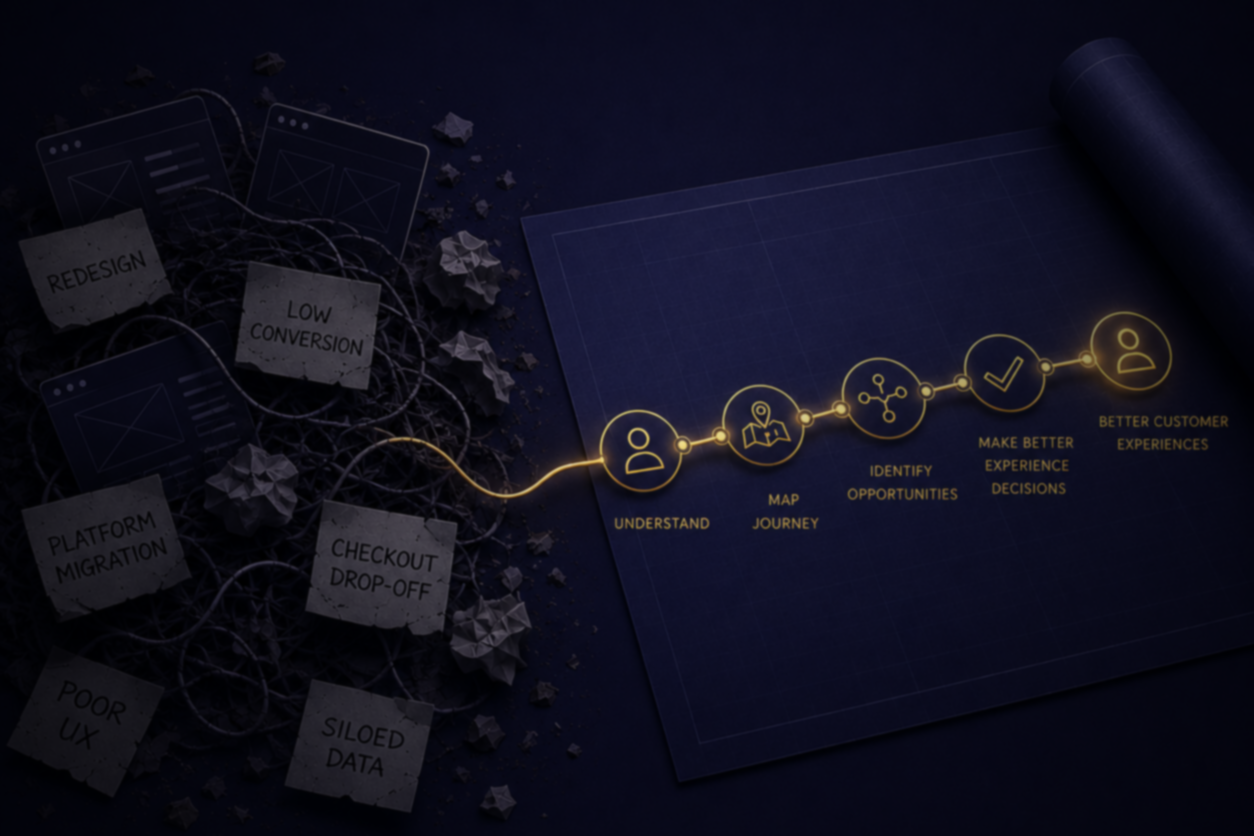
Customer Journey Thinking explains where it changes.
Commercial Diagnosis identifies where it is being lost.
Together they create experiences that support commercial decisions instead of merely presenting information.
Businesses often ask how they can persuade more customers to buy.
The better question is different.
What uncertainty have we failed to remove?
That question changes the conversation completely.
Related Knowledge
- Customer Intent
- Momentum Science
- Customer Journey Thinking
- Commercial Confidence
- Commercial Diagnosis
- Decision Architecture
- Decision Effort
- Customer Effort
- Customer Progression